
The gap this closes
An organization can hold a complete, current, conforming ISO 45001 hazard register and still be cited by a federal inspector — because the register is not the document the regulation asks for. US law requires a written certification of hazard assessment carrying four specific elements. A job hazard analysis is not one and does not carry them. This is the most common gap MSI finds in certified US operations, and it is invisible from inside the management system, because no clause of either standard points at it.
A complete, editable procedure covering ISO 45001:2018 Clause 6.1.2 and ISO 14001:2026 Clause 6.1 in one process — with the two scopes reconciled, the two registers kept apart, and every divergence between the standards decided and recorded.
Organizations holding both certificates almost always combine the exercise and rarely reconcile the systems. The same person walks the same site with the same clipboard and produces one spreadsheet with a column marked E and a column marked H&S. It looks efficient. It hides three things.
Thirteen points where ISO 45001 and ISO 14001 genuinely differ, each with the 45001 position, the 14001 position, the house standard adopted, and the alternative rejected with the reasoning. Rating scales, documented methodology, the hierarchy of controls, worker participation, life cycle, reach beyond the site, emergency situations, the legal register, risks and opportunities, when change is assessed, psychosocial hazards, documented information vocabulary, and the considerations that apply when planning action.
Then a scope reconciliation worksheet, then a confirmation sheet where you record which position you adopted for each of the thirteen. Your certification bodies will ask which you took, and they may be two different bodies asking separately. This is the part a buyer cannot easily assemble alone, and it is what the combined edition is for.
Neither standard requires any particular document to exist as the output of hazard identification. US federal law does, in a place that applies to almost every workplace.
The employer must verify that the required workplace hazard assessment has been performed, through a written certification identifying the workplace evaluated, the person certifying that the evaluation has been performed, the date or dates of the assessment, and identifying the document as a certification of hazard assessment. Appendix F.3 is that certification, as a form, produced under Section 7.15 wherever PPE is among the controls. One page, four elements, signed. It is the cheapest compliance item in the procedure and the most frequently missing.
Appendix F also covers protection from retaliation and the ways reporting gets suppressed — incentive schemes tied to injury counts, automatic post-incident testing, reporting routes that exist on paper and cost the user something in practice. Where reporting is suppressed, every number in the procedure is wrong in the same reassuring direction.
On jurisdiction. Appendix F is written to United States federal requirements. If you operate elsewhere the specific obligations differ and the principle does not: national law imposes duties no clause of either standard will point you at, and a conforming management system is not by itself a compliant one. F.5 lists the environmental obligations to determine and record for every site, rather than pretending a template can summarize environmental law.
| Standards | ISO 45001:2018 Clause 6.1.2, and ISO 14001:2026 Clause 6.1 — hazards, aspects, both legal registers, and the combined risks and opportunities register |
|---|---|
| Format | Microsoft Word (.docx), fully editable, no locked content and no macros |
| Length | 66 pages |
| Document control | Running header, uncontrolled-copy statement, automatic print date and page numbering already configured |
| Branding | Written under a fictional organization throughout, so you replace one name and one mark |
| Updates | Issued at MSI Template v1.1, October 2026, built to the published 2026 edition of ISO 14001 rather than to a draft |
| License | Perpetual, for use within the purchasing organization and by consultants on engagements they deliver. Not for resale or redistribution as a template. |
| Not included | ISO 45001 and ISO 14001 themselves. Purchase of the standards remains the user's responsibility. |
EHS managers in organizations holding both certificates, where safety and environment are one function and one person walks the site for both. Particularly useful where the two scopes have never been reconciled, where the hazard register and the aspects register share a spreadsheet, and where nobody has written down which standard's position the combined system actually took.
Four pages from the ISO 45001 + ISO 14001:2026 edition, watermarked. The document runs to 66 pages.
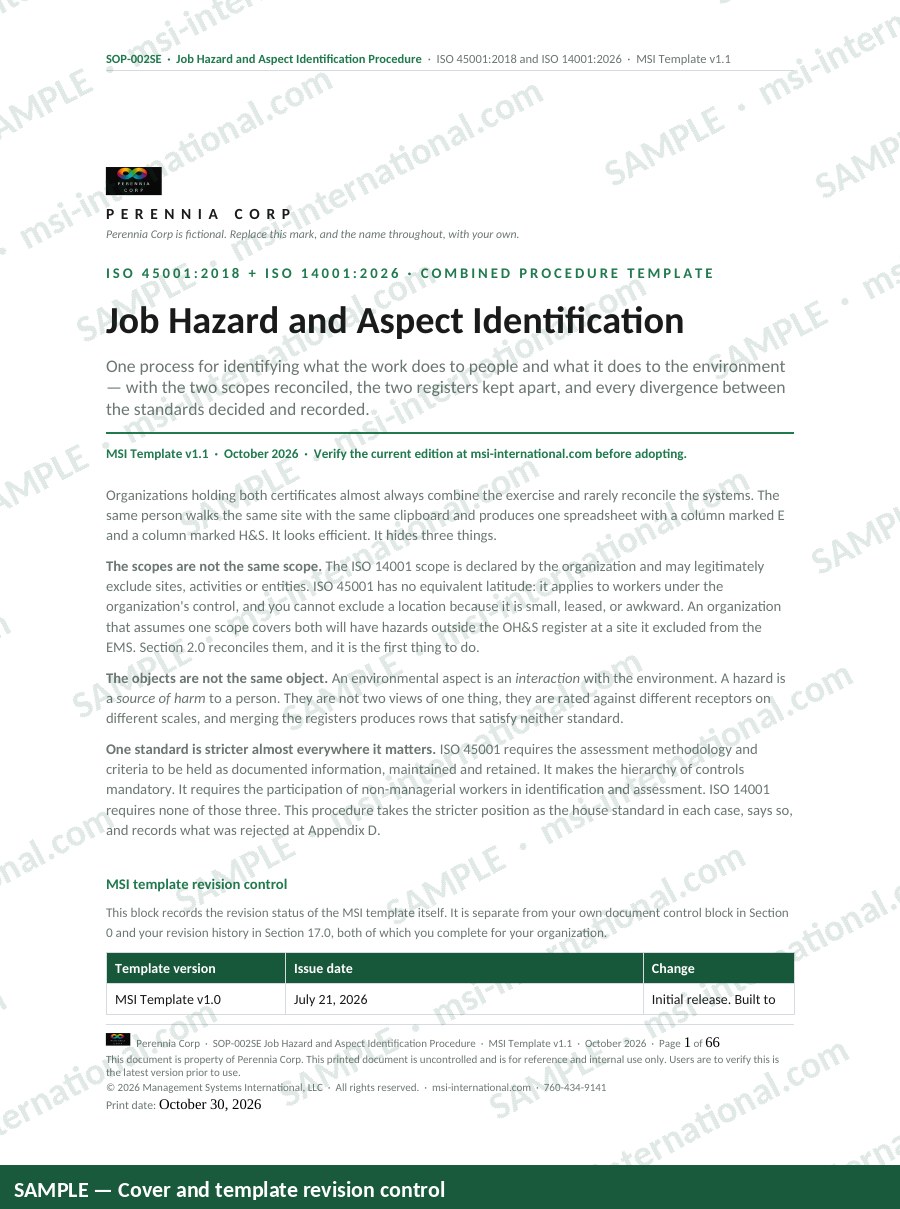 Cover and template revision control
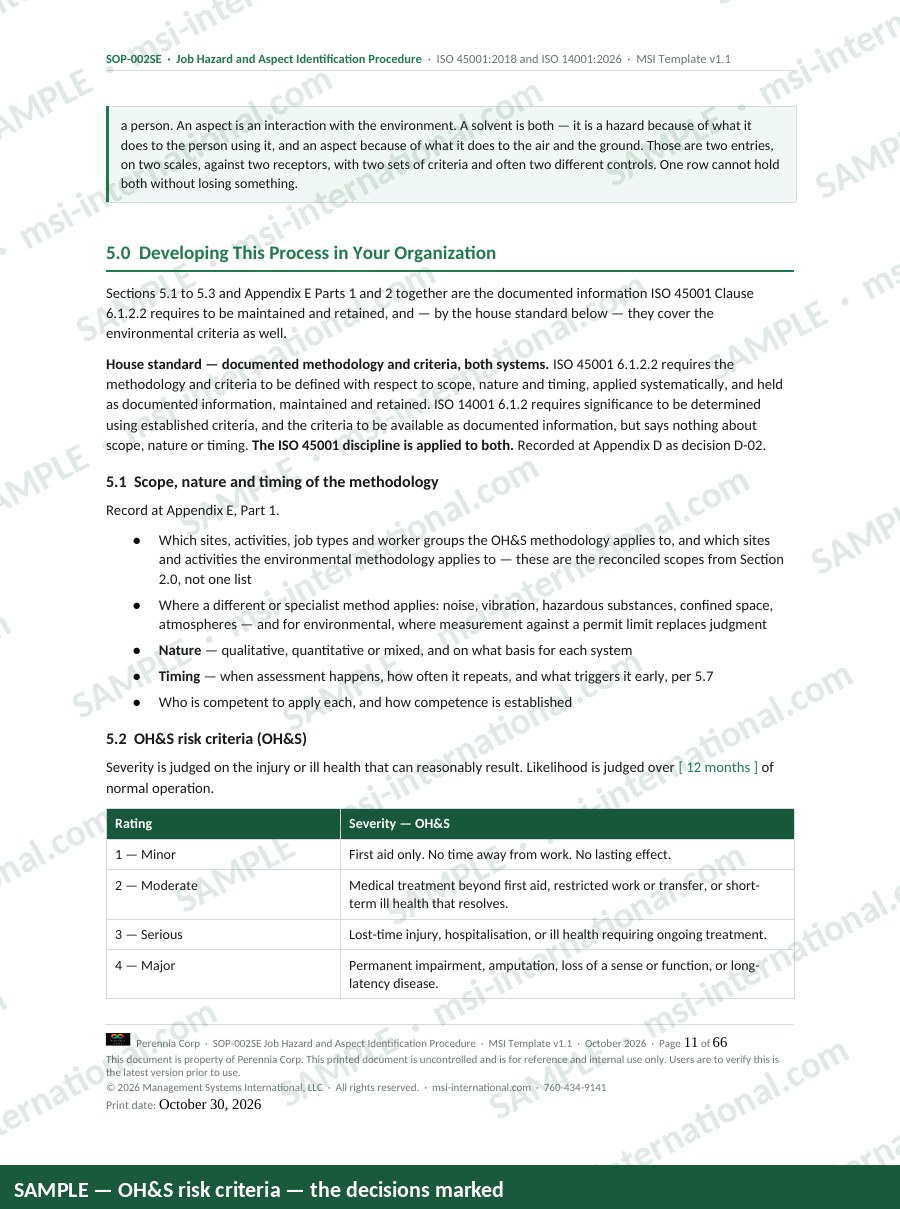 OH&S risk criteria — the decisions marked
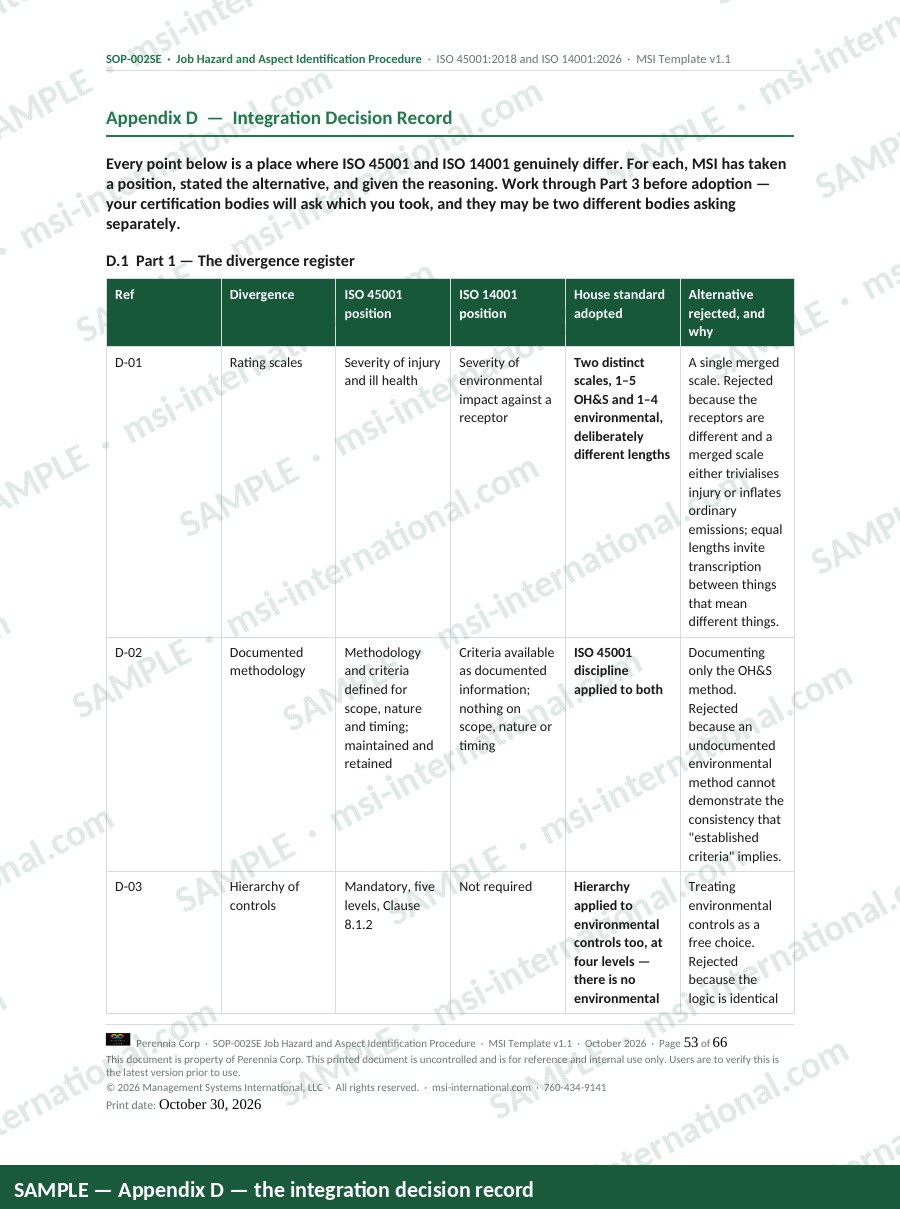 Appendix D — the integration decision record
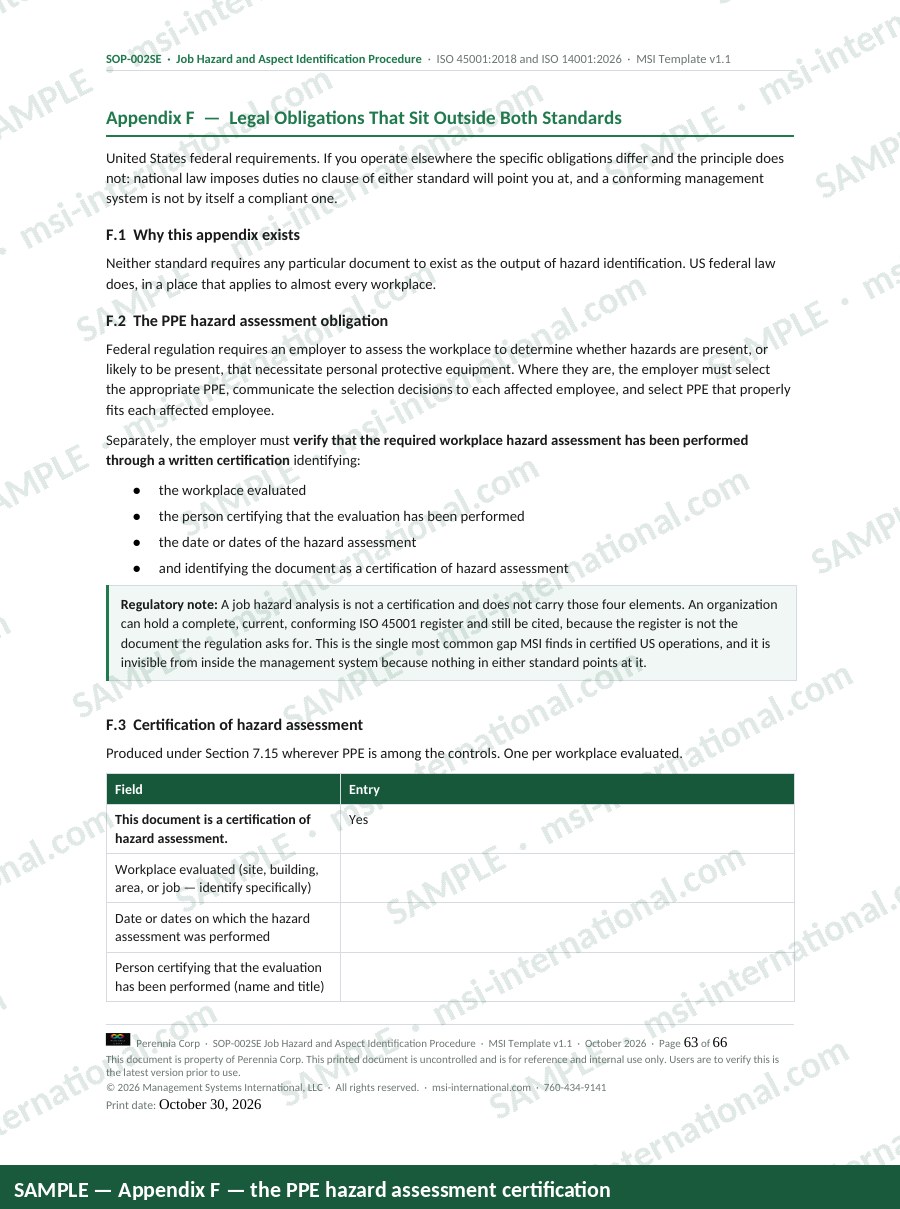 Appendix F — the PPE hazard assessment certification
Pages are watermarked. The file you receive is a clean, editable Word document.
Already certified to ISO 14001:2015? This procedure is written to the 2026 edition. The ISO 14001:2026 Transition course covers the whole revision rather than this clause alone, and is the quickest way to scope your own transition before you start editing documents. If your environmental system is new, build to the 2026 edition directly and skip the course.
Written from what repeats. Diana Lynn has attended more than 200 certification and surveillance audits across 28 years, supporting more than 80 certifications and training more than 600 professionals. These templates encode the structural weaknesses that show up again and again, not one organization's approach generalized. Management Systems International is veteran-owned and female-owned. Questions: 760-434-9141.
Prefer to be invoiced? If your organization buys on a purchase order rather than by card, email info@msi-international.com or call 760-434-9141 and we will raise an invoice. Tell us which templates or package you need and we will send payment terms the same working day.
Every variant covers one certification combination, so you buy the one document that matches your certificates rather than assembling it from singles.
This procedure is one document in a wider system. If you are building or rebuilding the whole documentation set rather than filling a single gap, the packages below collect the procedures and guides, and work out considerably cheaper than buying them individually.
Many organizations cannot pay for training or documentation by card. Tell us what you need and we will raise an invoice.
Complete the form below and we will send an invoice, usually the same business day. Delivery is identical whether you pay by card or by invoice.
Prefer to speak to someone? Call 760-434-9141 and we will handle it directly.

