
The gap this closes
Most environmental management systems keep one register and call it two things. The aspects table carries the scoring, the significance decisions and, somewhere in a spare column, whatever the organization thinks of as risk. The 2026 edition does not permit that reading. Clause 6.1.4 requires the risks and opportunities that need to be addressed to be available as documented information in their own right — and it reaches issues, interested party requirements and external environmental conditions, none of which is an aspect.
A complete, editable ISO 14001:2026 aspect identification procedure for Clause 6.1.2, carrying the second register the 2026 edition expects you to hold — written as a finished working document, not an outline.
An emerging water restriction in your catchment is not something your activities cause. It is something that happens to you. It belongs in a register the aspects table was never designed to hold, and in most environmental management systems that register does not exist.
It is a structural gap that has existed since risks and opportunities entered the standard in 2015, and that most systems never closed, because the aspects register already existed and nobody was told to build a second one. The 2026 edition makes both explicitly documented. That converts a long-standing weakness into a finding.
If your risks and opportunities currently live in a column of the aspects table, the work is not a rewrite. It is building one register you do not have, and knowing what belongs in it. Section 7.9 and Appendix A.4 do exactly that.
Four failures recur, and none of them are carelessness. Each is a place the standard asks a question the usual method does not answer.
Clause 6.1.2 requires significance to be determined using established criteria. Established means written down, agreed, and the same from one assessor to the next. Section 5.0 walks through setting them — the unit of analysis, what to look for, the severity anchors, the influence boundary, how combinations are handled, and how large the register should be — and records the result at Appendix E before the first aspect is rated.
There is a version field on every register row. When the criteria change, you can tell which entries were scored under which version, which is the difference between a register you can re-baseline and one you have to rebuild.
On the appendix lettering. This edition runs A, B, C, E, F. The letter D is reserved across the whole family for the integration decision record, which appears only in the combined variants. Nothing is missing.
Appendix F sets out what changed and what each change means for the register: the process for 6.1.2 to 6.1.5 is now an expected documented artifact; the maintain-and-retain vocabulary is retired in favor of "available as documented information"; risks and opportunities become a separately documented output; life cycle controls at 8.1 need four determinations; and change assessment moves before implementation at 6.3.
ISO 14001:2026 was published on 15 April 2026 and the transition runs three years. Your accreditation body's transition document governs the date, not this template and not a consultant's summary — Appendix F says so, and tells you what to confirm with your certification body.
| Standard | ISO 14001:2026, Clause 6.1.2, with the second register at 6.1.4 and planning action at 6.1.5 |
|---|---|
| Format | Microsoft Word (.docx), fully editable, no locked content and no macros |
| Length | 44 pages |
| Document control | Running header, uncontrolled-copy statement, automatic print date and page numbering already configured |
| Branding | Written under a fictional organization throughout, so you replace one name and one mark |
| Updates | Issued at MSI Template v1.1, October 2026, built to the published standard rather than to a draft |
| License | Perpetual, for use within the purchasing organization and by consultants on engagements they deliver. Not for resale or redistribution as a template. |
| Not included | ISO 14001 itself. Purchase of the standard remains the user's responsibility. |
Environmental managers and EMS leads implementing, maintaining or transitioning ISO 14001, and the consultants supporting them. Particularly useful where the aspects register was inherited rather than built, where influence has never been defined, and where risks and opportunities have always been a column rather than a register.
Four pages from the ISO 14001:2026 edition, watermarked. The document runs to 44 pages.
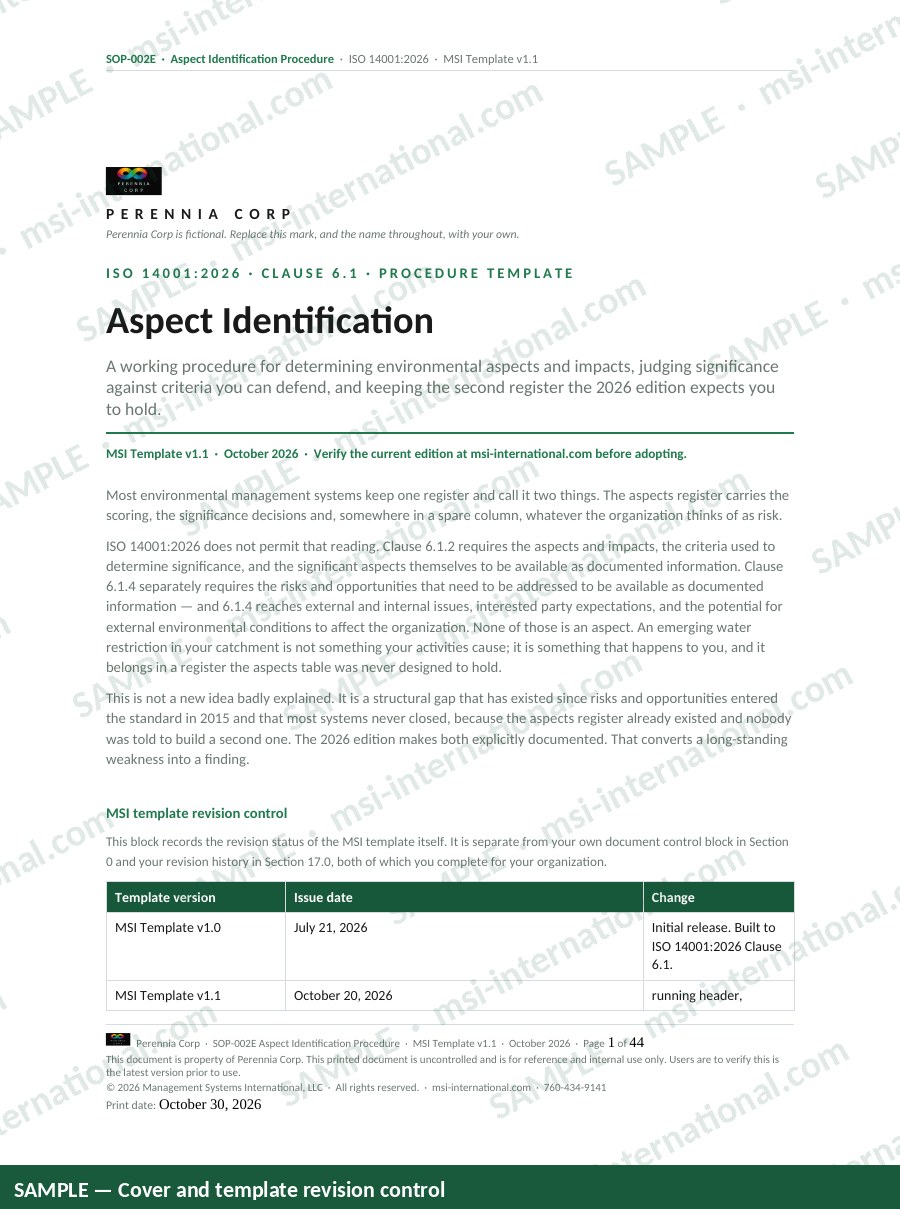 Cover and template revision control
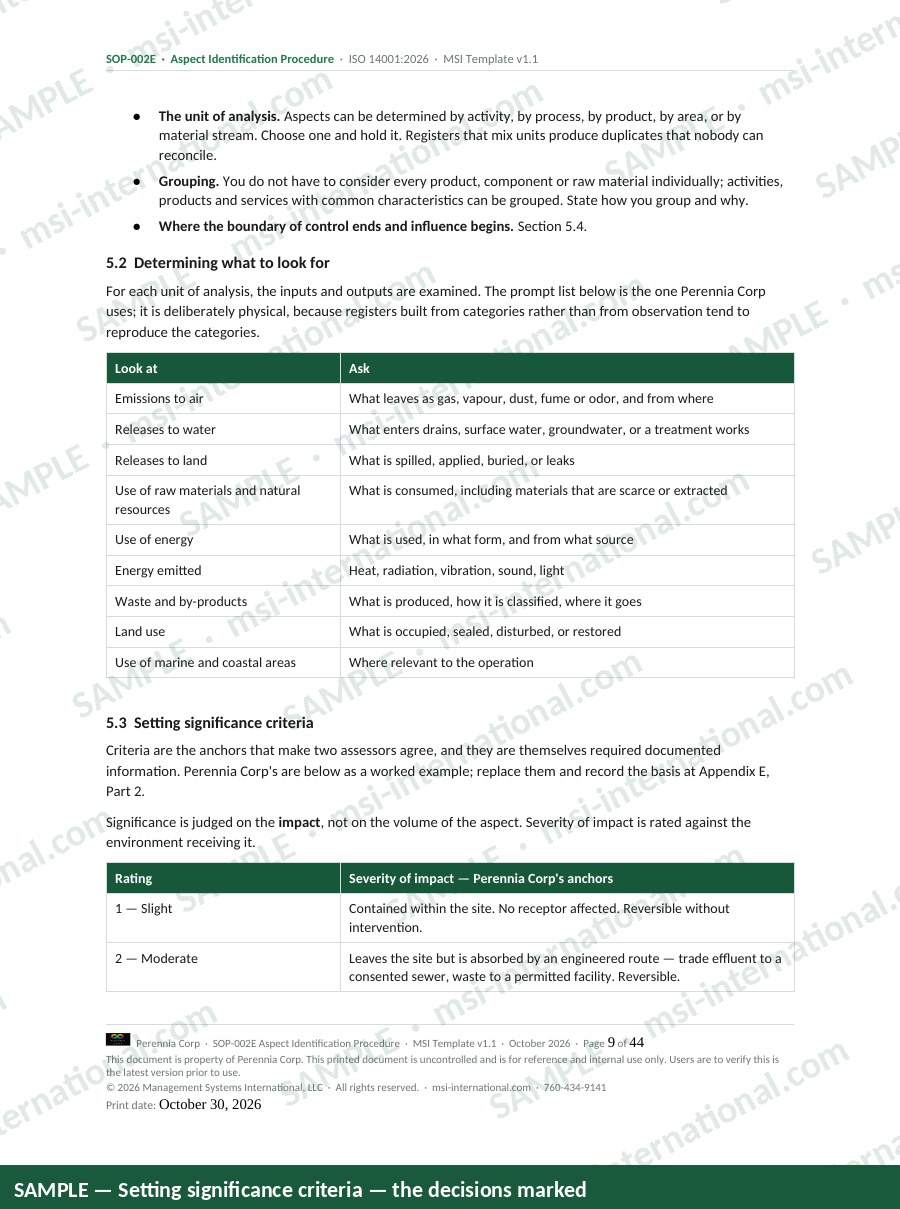 Setting significance criteria — the decisions marked
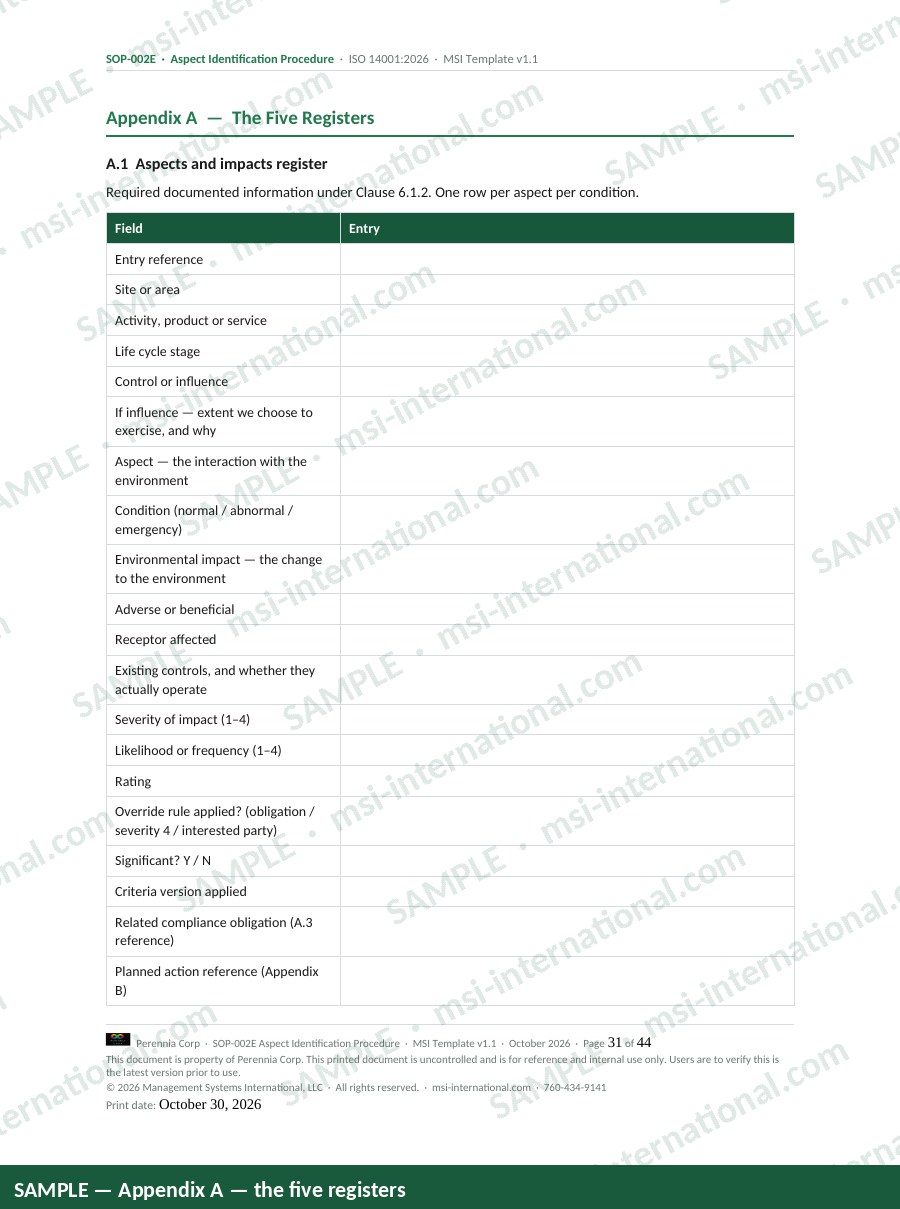 Appendix A — the five registers
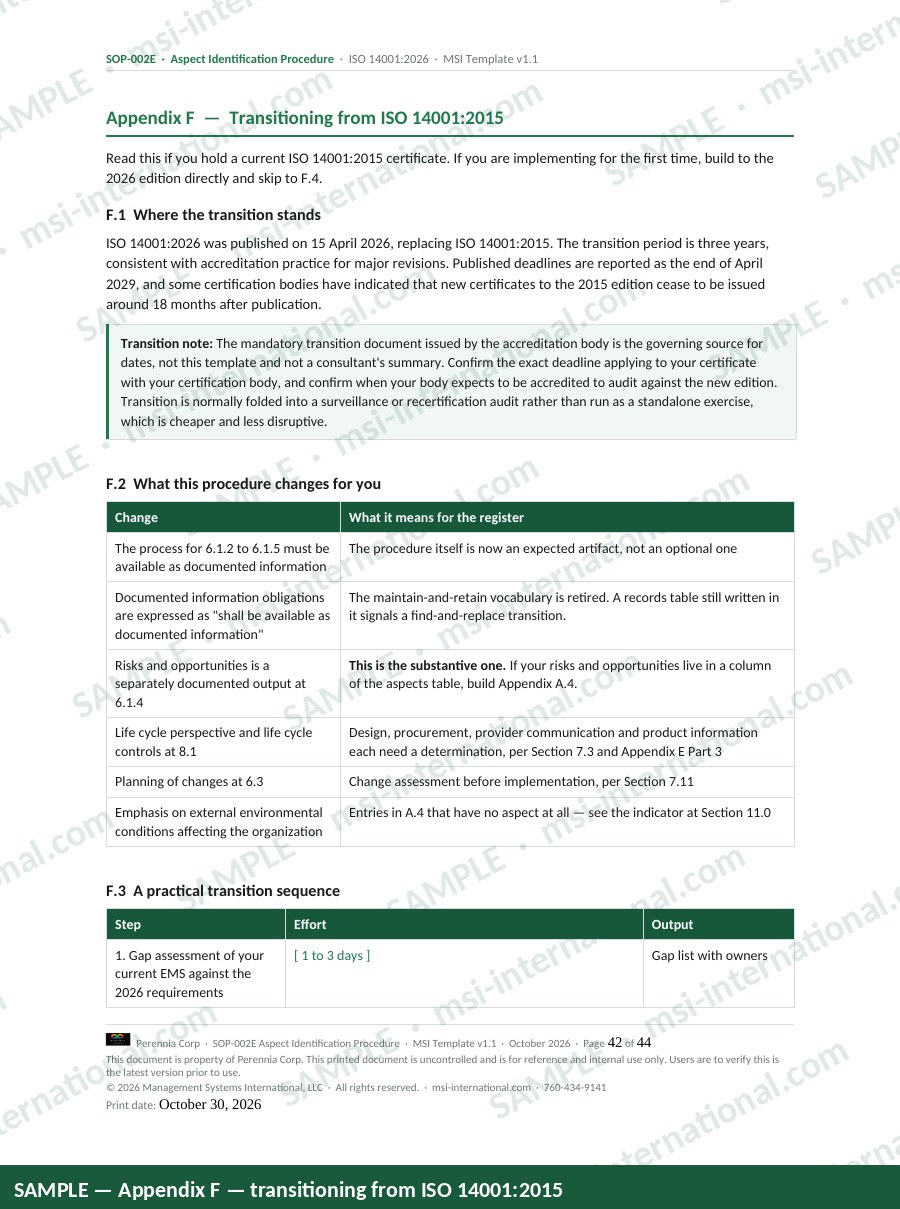 Appendix F — transitioning from ISO 14001:2015
Pages are watermarked. The file you receive is a clean, editable Word document.
Already certified to ISO 14001:2015? The ISO 14001:2026 Transition course covers the whole revision, not just this clause, and is the quickest way to scope your own transition before you start editing documents. If you are implementing for the first time rather than transitioning, build to the 2026 edition directly and skip the course.
Written from what repeats. Diana Lynn has attended more than 200 certification and surveillance audits across 28 years, supporting more than 80 certifications and training more than 600 professionals. These templates encode the structural weaknesses that show up again and again, not one organization's approach generalized. Management Systems International is veteran-owned and female-owned. Questions: 760-434-9141.
Prefer to be invoiced? If your organization buys on a purchase order rather than by card, email info@msi-international.com or call 760-434-9141 and we will raise an invoice. Tell us which templates or package you need and we will send payment terms the same working day.
Every variant covers one certification combination, so you buy the one document that matches your certificates rather than assembling it from singles.
This procedure is one document in a wider system. If you are building or rebuilding the whole documentation set rather than filling a single gap, the packages below collect the procedures and guides, and work out considerably cheaper than buying them individually.
Many organizations cannot pay for training or documentation by card. Tell us what you need and we will raise an invoice.
Complete the form below and we will send an invoice, usually the same business day. Delivery is identical whether you pay by card or by invoice.
Prefer to speak to someone? Call 760-434-9141 and we will handle it directly.

