
The gap this closes
Quality risk and environmental aspects are not found the same way. An aspect is a property of work being done in a place, and you find it by going there and watching. A quality risk is not visible on a walkway.
A complete, editable risk and aspect identification procedure for an organization certified to, or transitioning to, both ISO 9001:2026 and ISO 14001:2026 — written as a finished working document, not an outline.
Most organizations holding both certificates run two identification exercises that never meet. Quality risk is discussed in a management meeting. Environmental aspects are found on a site walk. The two outputs live in two places, are rated on two scales nobody compares, and are reviewed on two cycles.
Combining them is not a matter of merging two spreadsheets, because the two exercises genuinely differ. Send the site-walk team to find quality risk and the quality column fills with housekeeping observations — a label peeling, a bin unlabeled — and the organization concludes its quality risk is low when it has simply not been looked for.
This procedure runs Route A, observation of the work, for environmental aspects; and Route B, analysis of process performance, customer requirements, supplier behavior and nonconformity history, for quality risk. Both feed one shared assessment and treatment spine.
That is the integration, and it is real: one methodology, one threshold discipline, one action-tracking system, one review, one management review input. What is not integrated is the finding — because the finding genuinely differs.
ISO 14001:2026 is the stricter of the two almost everywhere the process itself is concerned. ISO 9001 requires the least at Clause 6.1 — no procedure, no criteria, no register — and contributes the obligation that makes the document necessary, at Clause 4.4.1 d): determined criteria and methods for the operation and control of every process. Risk identification is such a process.
Appendix D records sixteen divergences, each with what the two standards require, the position adopted as house standard, and the alternative rejected with its reasoning — followed by a sign-off table of decisions to confirm before adoption. It is the part a buyer cannot easily assemble alone, and it is what a certification body will ask about.
Written to ISO 9001:2026
ISO 9001:2026 was published on 16 September 2026, and this procedure is written to it and to ISO 14001:2026. Two editions are included: the clean edition to adopt as your procedure, and a Transition edition that marks every requirement new or materially changed since the 2015 edition with [2026] — so an organization already running a 2015-era risk process can see exactly what has to move before its transition audit.
Three pages from the ISO 9001:2026 and ISO 14001:2026 edition, watermarked. The document runs to 66 pages.
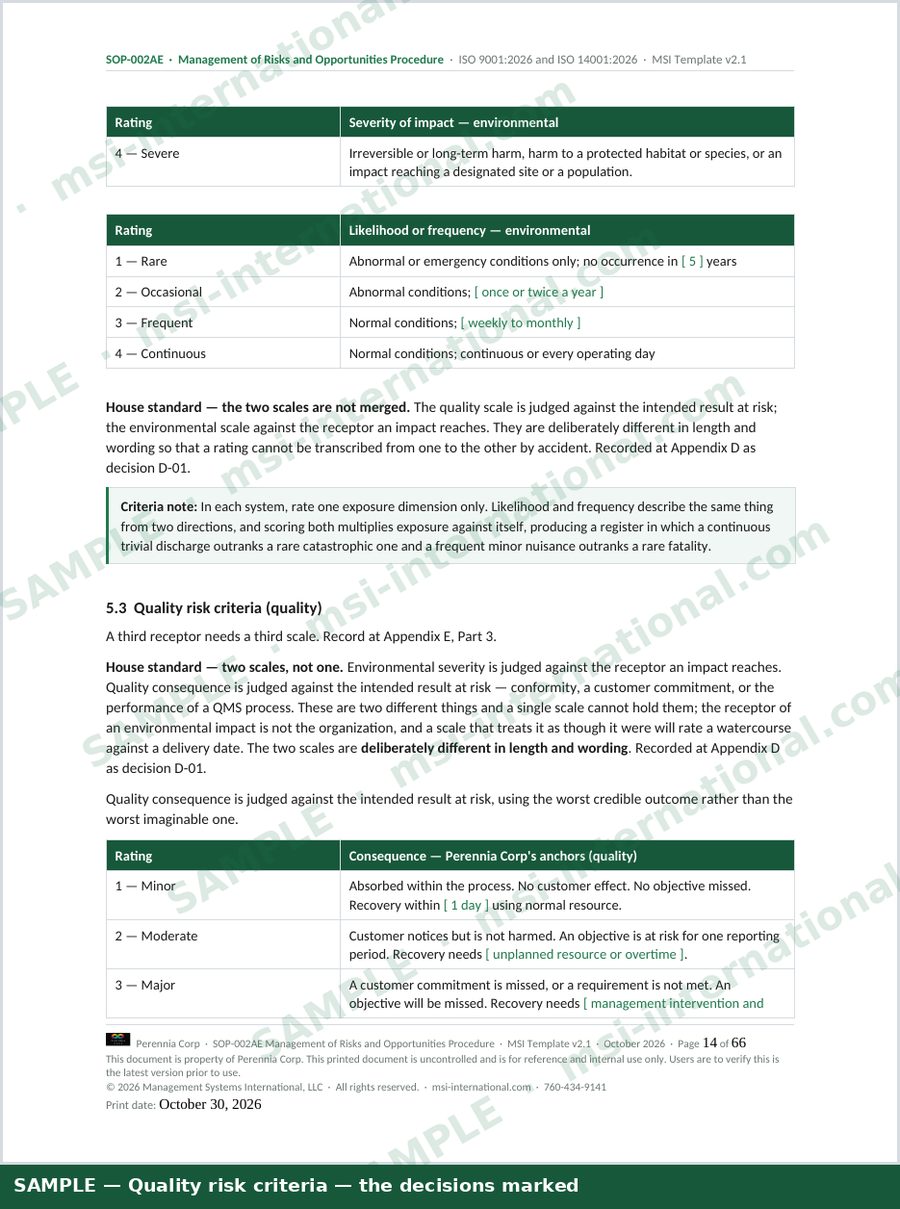 Quality risk criteria — the decisions marked
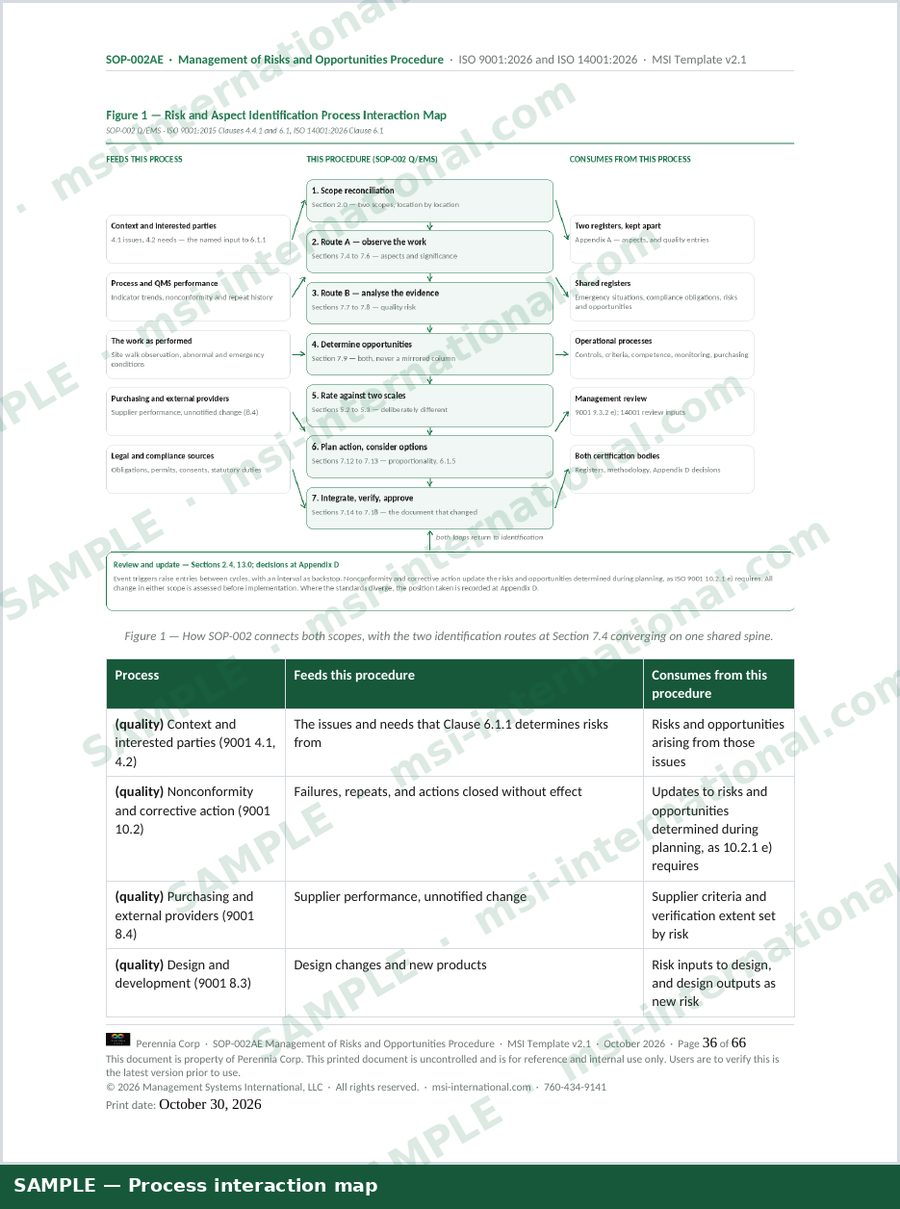 Process interaction map
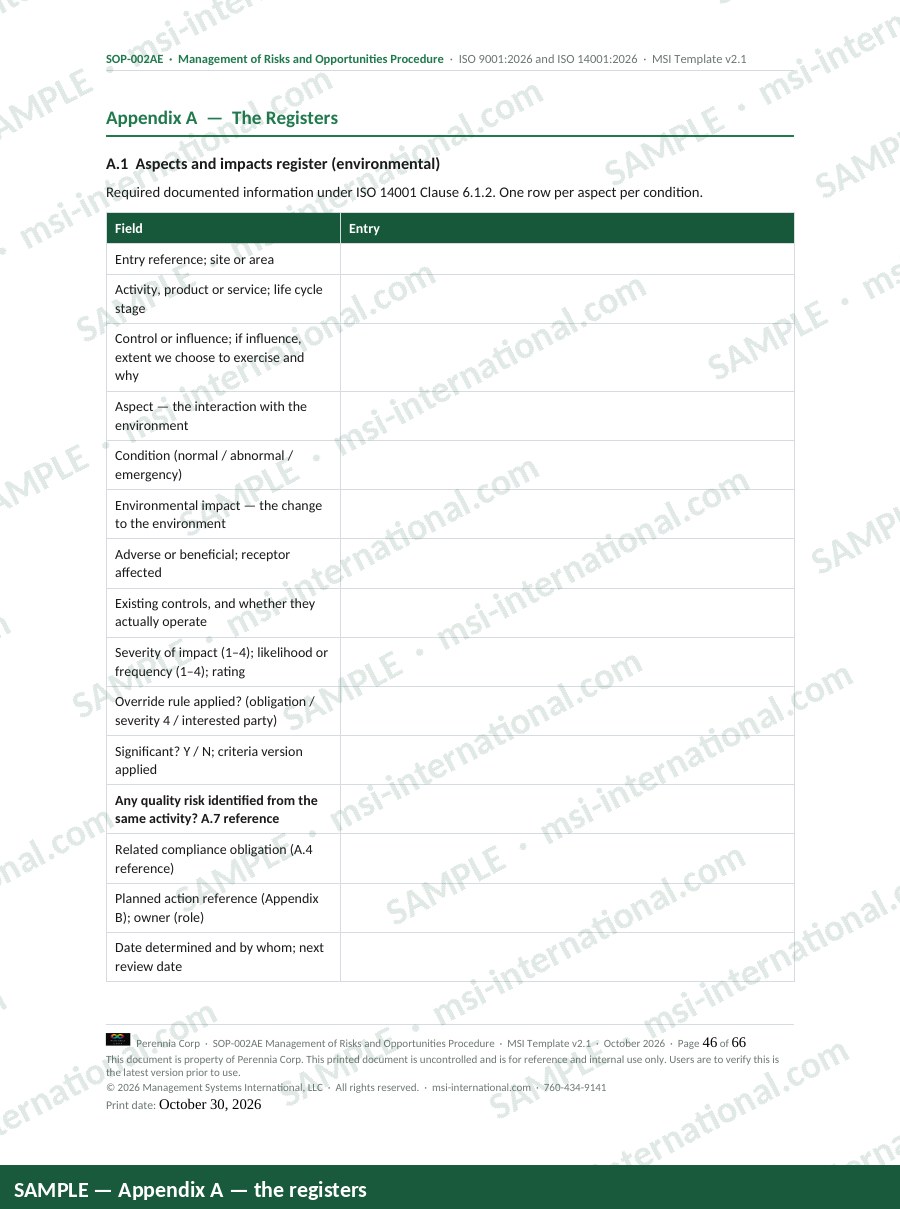 Appendix A — the registers
Pages are watermarked. The file you receive is a clean, editable Word document.
| Standards | ISO 9001:2026 and ISO 14001:2026 |
|---|---|
| Clauses | ISO 9001 Clauses 4.4.1 d) and 6.1.1 to 6.1.3; ISO 14001 Clause 6.1 |
| Length | 66 pages |
| Format | Microsoft Word (.docx), fully editable |
| Delivery | Instant download |
| License | Perpetual, non-exclusive license for your organization to edit, rebrand and adopt across your own sites |
| Editions | Two Word files: the clean ISO 9001:2026 edition, and a Transition edition with every change from the 2015 edition marked [2026] |
| Also included | MSI's QuickStart for this procedure — a six-page implementation route listing the twenty-nine decisions to make, in order, with the section where each is explained |
Quality and environmental managers, EHS leads carrying both systems, and consultants supporting dual-certified clients. Particularly useful for multi-site operations where the two scopes were never compared, for organizations transitioning to ISO 9001:2026 and ISO 14001:2026 inside their transition windows, and anywhere the aspects register is thorough and the quality risk register was written from memory of last year's problems.
Written from what repeats. Diana Lynn has attended more than 200 certification and surveillance audits across 28 years, supporting more than 80 certifications and training more than 600 professionals. These templates encode the structural weaknesses that show up again and again, not one organization's approach generalized. Management Systems International is veteran-owned and female-owned. Questions: 760-434-9141.
Prefer to be invoiced? If your organization buys on a purchase order rather than by card, email info@msi-international.com or call 760-434-9141 and we will raise an invoice. Tell us which templates or package you need and we will send payment terms the same working day.
Every variant covers one certification combination, so you buy the one document that matches your certificates rather than assembling it from singles.
This procedure is one document in a wider system. If you are building or rebuilding the whole documentation set rather than filling a single gap, the packages below collect the procedures and guides for each standard, and work out considerably cheaper than buying them individually.
There is an ISO 9001 + ISO 14001:2026 package; the integrated package below adds ISO 45001, or buy each standard's package separately. Each package collects every MSI procedure template and guide for its standard set in one purchase, at a package price:
Many organizations cannot pay for training or documentation by card. Tell us what you need and we will raise an invoice.
Complete the form below and we will send an invoice, usually the same business day. Delivery is identical whether you pay by card or by invoice.
Prefer to speak to someone? Call 760-434-9141 and we will handle it directly.

