
The gap this closes
No clause of ISO 9001 requires you to have a risk procedure. Clause 6.1 asks for no method, no register and no documented information. The obligation arrives at Clause 4.4.1 d), which requires determined criteria and methods for every process in the system. Risk identification is a process. If three people do it three different ways, the finding is written against 4.4.1 — and most organizations are still looking at 6.1 when it lands.
A complete, editable ISO 9001:2026 risk and opportunity procedure covering Clauses 6.1.1, 6.1.2 and 6.1.3 — written as a finished working document with the judgment calls already made and annotated, not as an outline.
The 2026 edition asks for considerably more than the 2015 edition did, and the change is easy to read past. Clause 6.1.2 now requires the organization to determine, analyse and evaluate risks. Those middle two words are new. In 2015 the clause asked only that you plan. An assessment that produces a rating nobody can reproduce no longer satisfies the words on the page.
The 2026 edition splits them at determination and action (6.1.2 and 6.1.3), again at analysis (9.1.3 e) and f)), and again at management review (9.3.2 g) and h)). A register that carries opportunity as a column beside risk cannot satisfy six separate requirements from one entry.
The part that catches people is that each now carries its own test, and they are not the same question.
Risk — 6.1.2
Actions proportionate to the potential impact of the risks on the intended results of the quality management system. Widened from 2015, which tied proportionality to the conformity of products and services.
Opportunity — 6.1.3
Actions appropriate to the organization's context and supporting the achievement of desired results. Not proportionality. A different question, and one a risk matrix cannot answer.
This is the question the revision has produced most often, and the answer is no. Clauses 6.1.2 and 6.1.3 are separate obligations. Neither says separate procedure, separate register or separate owner, and the published Annex states that risks and opportunities can be determined and addressed through separate processes — can, not must. A good deal of commentary is still quoting the draft, which put that more strongly than the published text does.
The separation the standard asks for is at the entry and at the test, not at the document. An opportunity recorded as a column beside a risk has one owner, one rating and one line, and cannot carry six separate requirements. An opportunity recorded as an entry in its own right can.
So this is one procedure and one register. Section 7.7 gives opportunity two routes in — arising from the treatment of a risk, and standing alone through the question asked at Section 7.4 — and both are recorded as entries in Appendix A rather than as an attachment to something that went wrong. The two then converge on one assessment and treatment spine. You keep the system you have and change how entries arrive and how they are judged.
The four ends at Clause 6.1.1 were reordered. In 2015, b) read "enhance desirable effects." In 2026, b) reads "prevent, or reduce, undesired effects," and the opportunity end moved to d). Anyone citing 6.1.1 b) for opportunity from memory is now citing the risk item. Section 15.0 maps every clause this procedure touches to the section that satisfies it, so the citations in your document are right whether or not you re-read the standard.
One purchase includes both.
On the appendix lettering. This edition runs A, B, C, E, F. The letter D is reserved across the whole family for the integration decision record, which appears only in the combined variants. Nothing is missing.
Four pages from the ISO 9001:2026 edition, watermarked. The document runs to 44 pages.
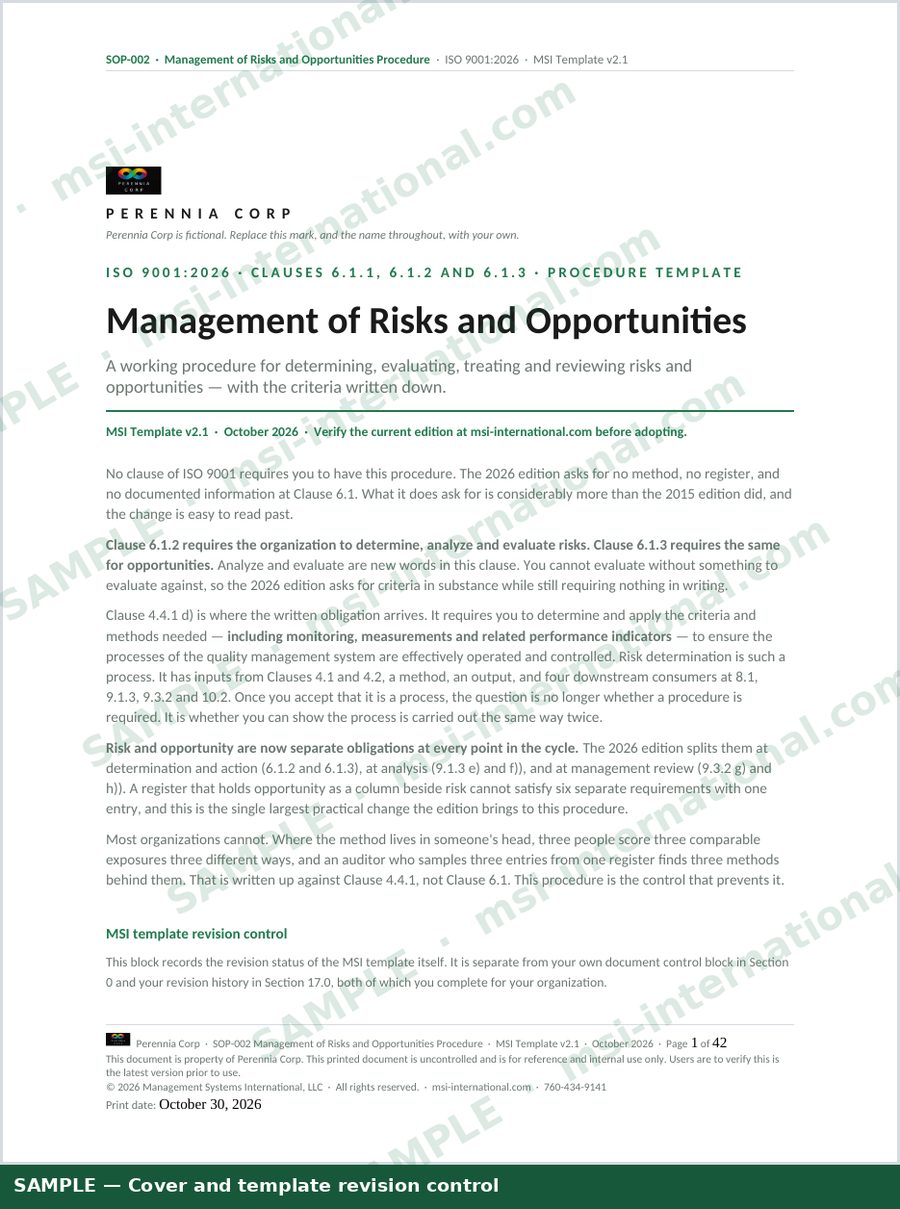 Cover and template revision control
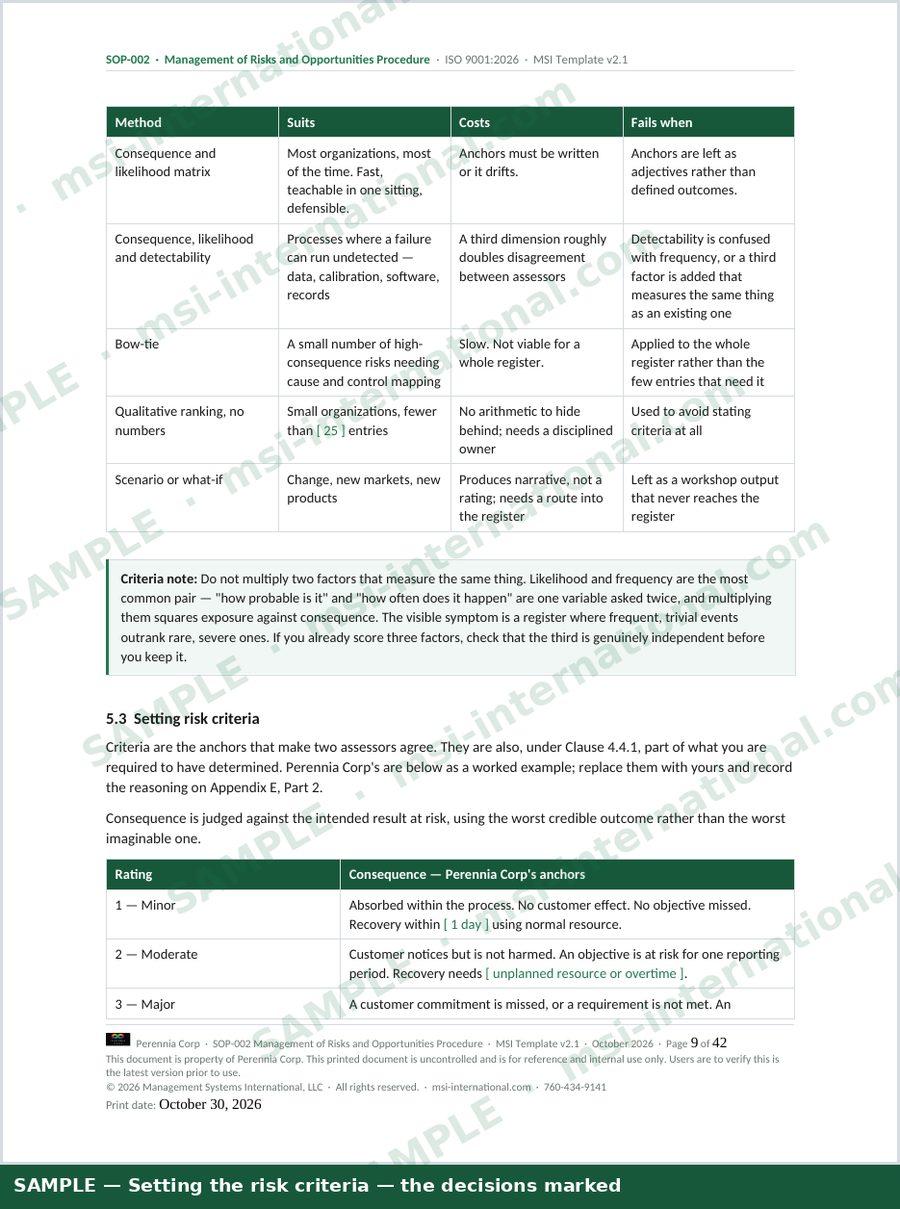 Setting the risk criteria — the decisions marked
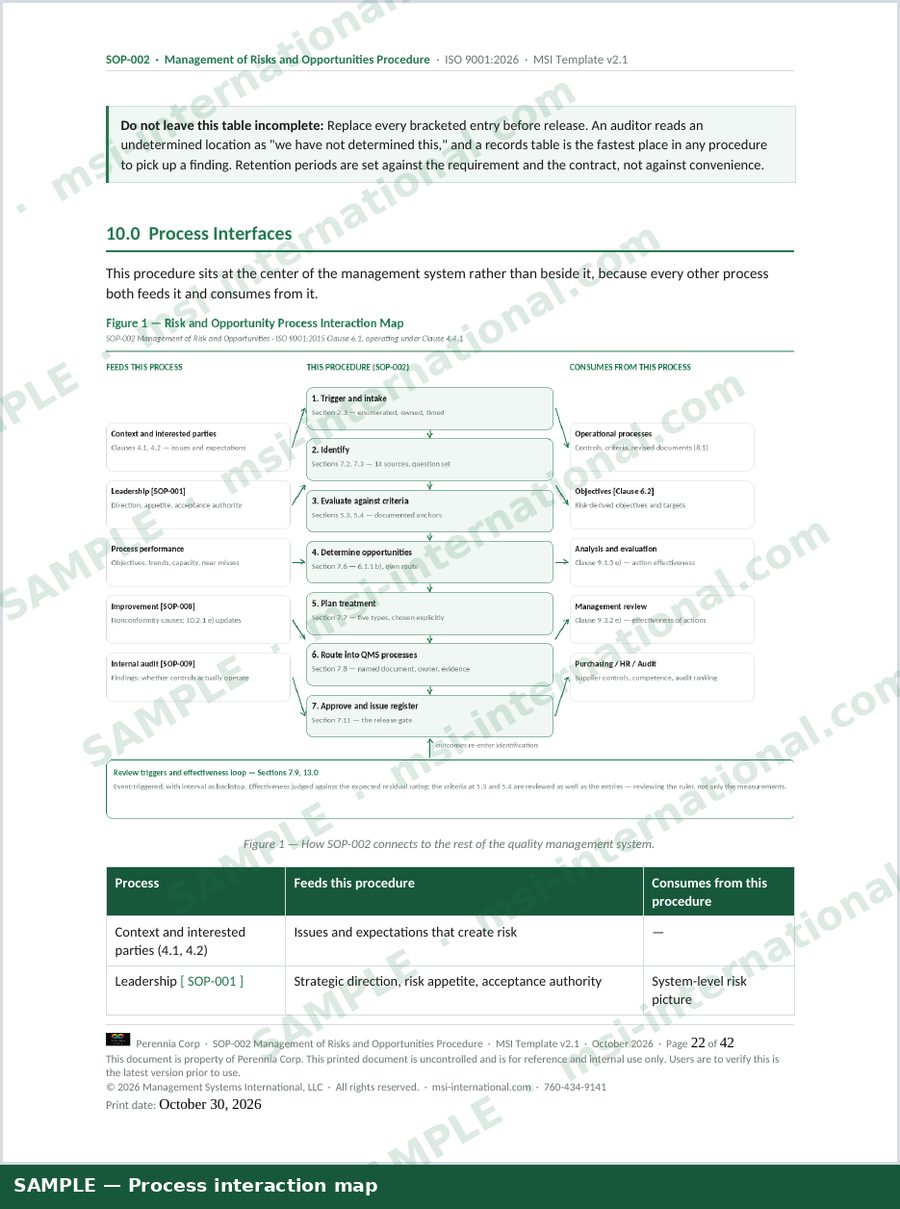 Process interaction map
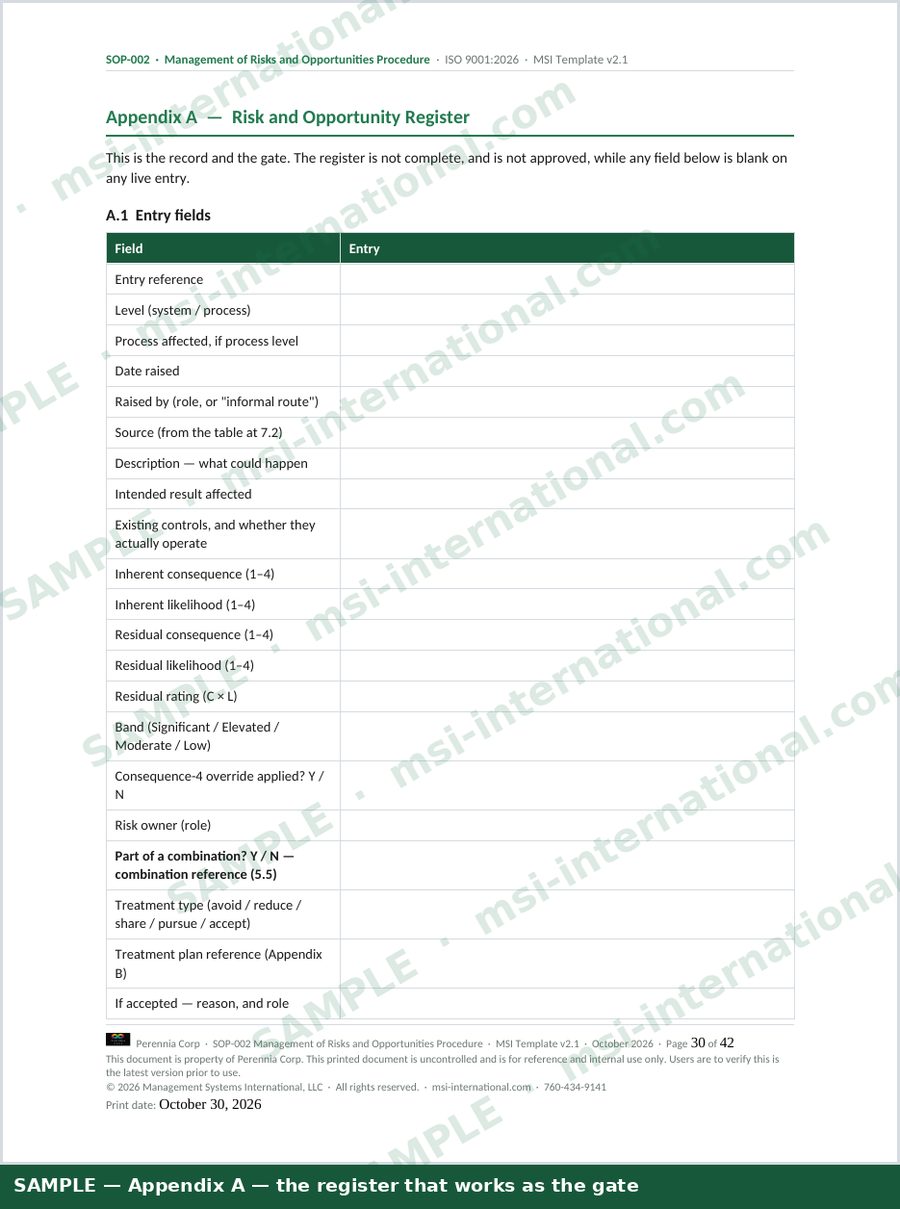 Appendix A — the register that works as the gate
Pages are watermarked. The file you receive is a clean, editable Word document.
| Standard | ISO 9001:2026, Clauses 6.1.1, 6.1.2 and 6.1.3, with the consuming clauses at 4.4.1, 9.1.3, 9.3.2 and 10.2.1 |
|---|---|
| Format | Microsoft Word (.docx), fully editable, no locked content and no macros |
| Length | 44 pages clean edition, 48 pages transition edition |
| Document control | Running header, uncontrolled-copy statement, automatic print date and page numbering already configured |
| Branding | Written under a fictional organization throughout, so you replace one name and one mark |
| License | Perpetual, for use within the purchasing organization and by consultants on engagements they deliver. Not for resale or redistribution as a template. |
| Updates | Issued at MSI Template v2.1, October 2026, built to the published standard rather than to a draft |
| Also included | MSI's QuickStart for this procedure — a six-page implementation route listing the twenty-eight decisions to make, in order, with the section where each is explained |
| Not included | ISO 9001 itself. Purchase of the standard remains the user's responsibility. |
Quality managers and ISO consultants transitioning a certified system from ISO 9001:2015 to the 2026 edition, and organizations building a risk process for the first time. Particularly useful where the register was produced by one person, where opportunity exists as an empty column, and where the criteria behind the ratings live in somebody's head rather than in a controlled document.
Written from what repeats. Diana Lynn has attended more than 200 certification and surveillance audits across 28 years, supporting more than 80 certifications and training more than 600 professionals. These templates encode the structural weaknesses that show up again and again, not one organization's approach generalized. Management Systems International is veteran-owned and female-owned. Questions: 760-434-9141.
Prefer to be invoiced? If your organization buys on a purchase order rather than by card, email info@msi-international.com or call 760-434-9141 and we will raise an invoice. Tell us which templates or package you need and we will send payment terms the same working day.
Every variant covers one certification combination, so you buy the one document that matches your certificates rather than assembling it from singles.
This procedure is one document in a wider system. If you are building or rebuilding the whole documentation set rather than filling a single gap, the packages below collect the procedures and guides, and work out considerably cheaper than buying them individually.
Many organizations cannot pay for training or documentation by card. Tell us what you need and we will raise an invoice.
Complete the form below and we will send an invoice, usually the same business day. Delivery is identical whether you pay by card or by invoice.
Prefer to speak to someone? Call 760-434-9141 and we will handle it directly.

